
Key takeaways
- Each tile in Terraria equals 2 in-game feet (16 × 16 pixels), so converting between TerraMap tile X/Y and Compass/Depth Meter feet is simple arithmetic.
- Small (4,200 × 1,200), Medium (6,400 × 1,800), and Large (8,400 × 2,400) worlds do not just scale travel time — they also scale chest counts, Floating Islands, and Shrines.
- Knowing exact Underground vs Cavern and Space elevation boundaries prevents wasted hours building mob farms or sky bridges at the wrong Y coordinate.
Small vs Medium vs Large: exact dimensions and gameplay trade-offs
When creating a new Terraria world, choosing between Small, Medium, and Large is the single longest-lasting decision of the save. Unlike difficulty or character gear, world dimensions cannot be resized later. Each tier expands both horizontal width and vertical depth substantially, altering everything from travel pacing and Hardmode biome spread to how many chests and shrines world generation can place.
Small worlds feel brisk in single-player: walking from Spawn to either Ocean takes less than two minutes once you have Hermes Boots, and digging a Hellevator to the Underworld takes a fraction of the time. The trade-off is scarcity — Small worlds generate fewer Surface Chests, fewer Sky Islands, a shallower Cavern layer (meaning Wyverns and Harpies bother you closer to high arenas), and far less margin before Hardmode Corruption or Crimson creeps near spawn.
Medium worlds are widely considered the sweet spot for solo and duo runs. You get roughly 2.29× the total tile area of a Small world, plenty of chest rolls for rare accessories like Lava Charms and Ice Skates, and generous vertical room for boss arenas without endless walking. Large worlds shine for 3+ player servers, mega-builders, and completionists who want maximum loot rolls and deep underground biomes.
| World Size | Tile Dimensions (W × H) | Total Tiles | Floating Islands (typical) | Enchanted Sword Shrines (typical) | Best For |
|---|---|---|---|---|---|
| Small | 4,200 × 1,200 | 5,040,000 | 3 islands | 1–2 shrines | Fast solo runs, speedrunning, quick resource worlds |
| Medium | 6,400 × 1,800 | 11,520,000 | 5 islands | 2–3 shrines | Balanced solo/co-op playthroughs (recommended default) |
| Large | 8,400 × 2,400 | 20,160,000 | 6–9 islands | 3–4 shrines | Multiplayer servers, long-term building, maximum chests |
How to convert TerraMap X/Y tile coordinates to Compass & Depth Meter feet
One of the most common points of confusion when using a map viewer or verified seed list is why a coordinate like X 2393, Y 368 looks completely different from the numbers displayed by the Compass and Depth Meter inside Terraria.
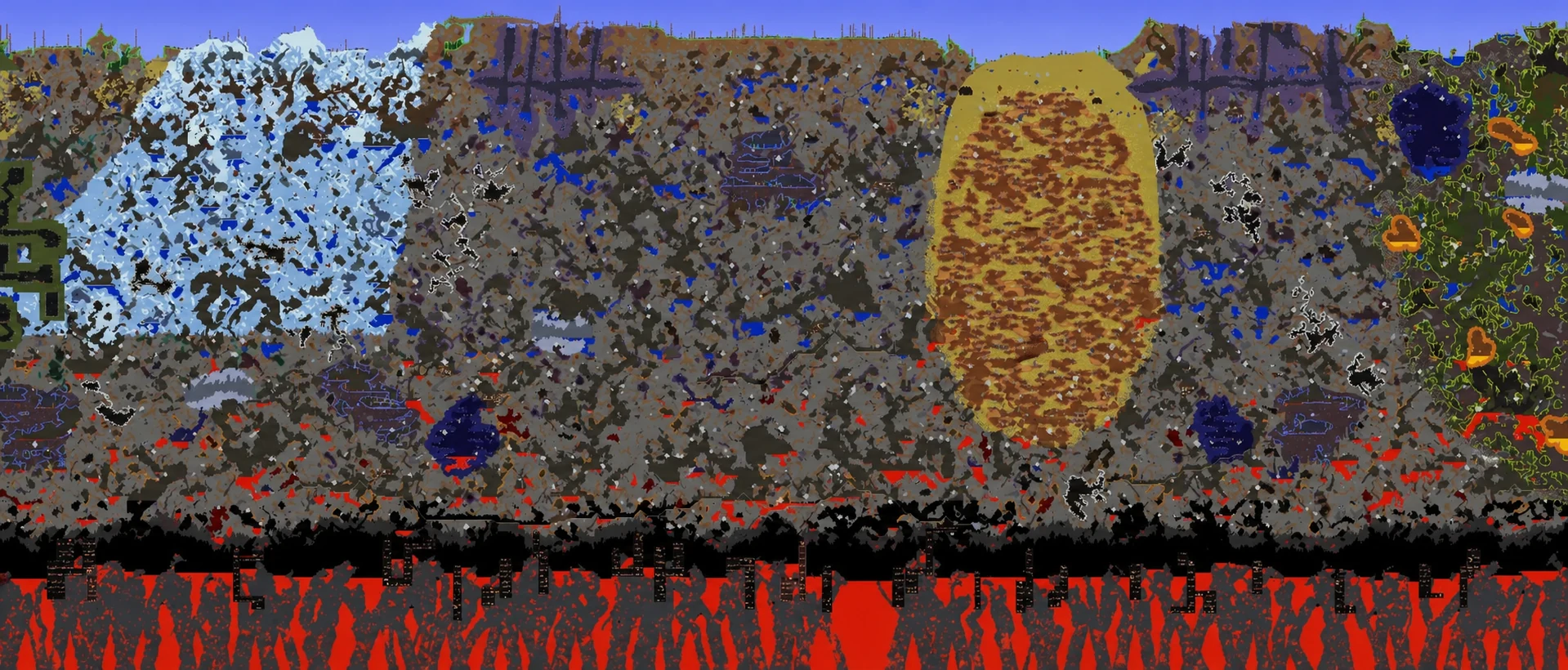
Inside the .wld file (and inside TerraMap), coordinates start at (0, 0) in the top-left corner of the map. X increases from left (West) to right (East), and Y increases downward from the top of Space to the bottom of the Underworld. Inside the game UI, however, Terraria converts tile offsets into feet by multiplying by 2, measuring X outward from the horizontal center of the world and Y upward or downward from the world Surface Level line.
- Horizontal (Compass): Compass Feet = (Tile X − WorldWidth / 2) × 2. Negative values read West; positive values read East.
- Example on a Medium world (width 6,400, center X = 3,200): Tile X 2,393 equals (2,393 − 3,200) × 2 = −1,614, which displays as "1614 West".
- Vertical (Depth Meter): Depth Feet = (Tile Y − SurfaceLevelY) × 2. Negative values read Surface/Space (above 0); positive values read Underground/Cavern (below 0).
- Exact SurfaceLevelY varies slightly per world (roughly Y 340–390 on Small, Y 490–560 on Medium, Y 630–730 on Large). You can inspect your world’s exact surface line inside TerraMap’s World Properties panel.
The five vertical layers and what spawns in each
Terraria divides every map vertically into five distinct layers: Space, Surface, Underground, Cavern, and the Underworld. Enemy pools, chest loot tables, ore density, and music tracks all key directly off which layer the player occupies — not just the blocks around them.
Space occupies the uppermost slice of the map where gravity weakens, the sky turns dark even at noon, and Harpies (plus Wyverns in Hardmode) spawn. Building a skybridge or Moon Lord arena too close to the Space boundary invites Wyvern ambushes mid-boss fight.
The Surface stretches from the bottom of Space down to 0 ft (the Surface Level). Wooden Chests appear here containing Aglets, Climbing Claws, Step Stools, and Blowpipes. Immediately beneath 0 ft lies the Underground layer, identifiable by warm brown dirt background walls. Gold Chests begin appearing here with Hermes Boots, Cloud in a Bottle, and Band of Regeneration.
Below the dirt-to-rock transition begins the Cavern layer — the thickest stratum in any world, marked by gray rocky background walls. Cavern-exclusive drops include Lava Charms (in the deeper lava sub-layer), Enchanted Boomerangs, Underground Cabins with richer loot, and the bulk of Hardmode Tier 2 and Tier 3 ores (Mythril/Orichalcum and Adamantite/Titanium). Finally, the bottom ~200 tiles of every world form the Underworld: Ash, Hellstone, Ruined Houses, Shadow Chests, and the Wall of Flesh arena.
| Layer | Visual Wall / Sky Cue | Key Chests & Structures | Critical Mechanics |
|---|---|---|---|
| Space | Dark sky, reduced gravity | Skyware Chests (near lower Space / upper Surface) | Harpies (Pre-HM), Wyverns (Hardmode), Martian Probes |
| Surface | Day/night sky, grass & trees | Wooden Chests, Living Trees, Pyramids | Town NPCs, invasion events, Fallen Stars |
| Underground | Warm brown dirt wall | Gold Chests, Underground Cabins, Gem Caves | Depth 0 ft down to rock layer; early ores & Life Crystals |
| Cavern | Gray stone wall; lava in lower half | Gold/Frozen/Ivy/Sandstone Chests, Aether, Spider Caves | Soul of Light/Night farming, Chaos Elementals, Hardmode ores |
| Underworld | Fiery volcanic background | Ruined Houses, Shadow Chests (Shadow Key) | Hellstone mining, Lava fishing, Wall of Flesh fight |
Why exact layer boundaries matter for farms and boss arenas
Countless player questions — "Why aren’t Souls of Light dropping?" or "Why won’t Rod of Discord Chaos Elementals spawn?" — trace back to standing in the Underground layer instead of the Cavern layer. Souls of Light and Night, Biome Mimics, and Chaos Elementals strictly require the Cavern layer. Standing 10 tiles above the Underground/Cavern rock-wall line yields zero Souls no matter how much Pearlstone you place.
Similarly, constructing a classic 168 × 94 tile AFK mob farm works best deep in the middle Cavern layer (safely below the dirt-to-rock transition, yet above the Underworld ceiling so Hellbats and Lava Slimes do not hijack the spawn cap). Checking your exact Y coordinates in TerraMap before clearing a farm rectangle saves hours of digging and lets you avoid accidentally clipping into a Dungeon or Lihzahrd Temple corner.
Frequently asked questions
How big is one tile in Terraria?
One Terraria tile is 16 × 16 pixels and equals 2 in-game feet on the Compass and Depth Meter. A standard player character stands 2 tiles wide by 3 tiles tall (4 feet by 6 feet).
Why does TerraMap show Y = 500 when my Depth Meter says 0 Surface?
TerraMap displays raw .wld tile indices measured from the very top edge of Space (Y = 0). The in-game Depth Meter shifts zero down to the Surface Level line and doubles tile distances into feet.
Which world size gives the highest chance of rare chest items?
Large worlds generate the most Underground Cabins, Floating Islands, and biome chests, giving the highest raw odds of rolling rare accessories like Lava Charms, Ice Skates, and Water Walking Boots without needing to fish crates.