
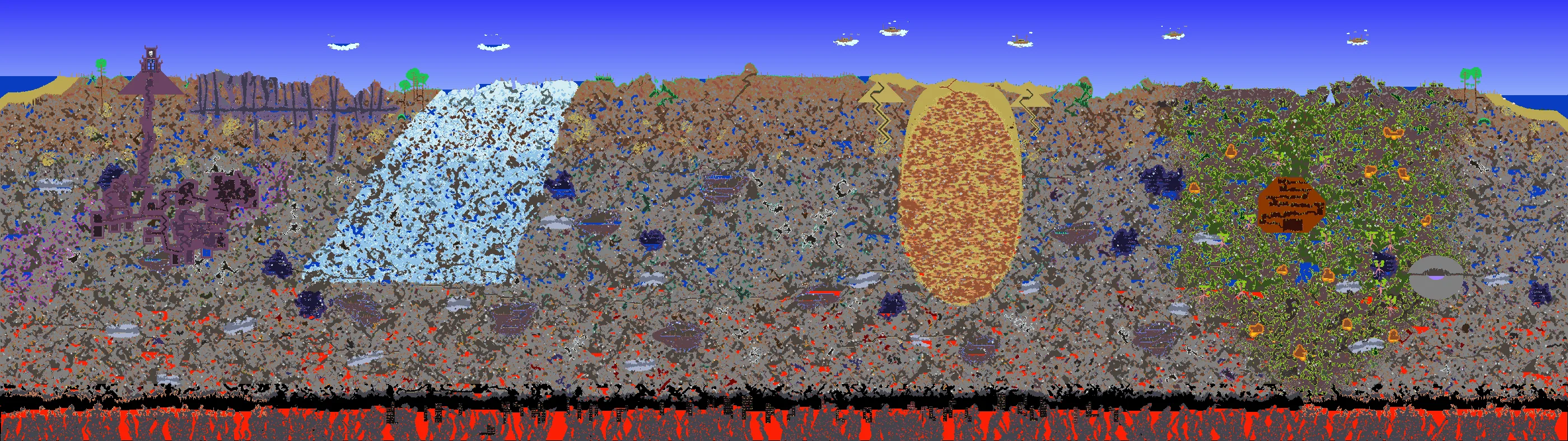
Key takeaways
- Every standard world places Snow and Dungeon on one half, and Jungle, Underground Desert (usually), and Aether on the opposite half.
- Floating Islands sit in a predictable vertical band right below Space — Gravitation Potions or Meteor Shot bouncing off the ceiling locate all of them in minutes.
- The Jungle Temple always spawns inside the Underground Jungle (occasionally poking out its outer rim), and Spider Nests spawn throughout the Cavern layer.
The hidden symmetry of every Terraria world
Terraria worlds feel wildly random on the surface, yet the world generator follows strict opposing-side rules that tell you where nearly every major landmark sits within two minutes of spawning.
Once you walk left or right from Spawn and find either the Snow biome or the Jungle, you immediately know the macro layout of the entire map. The Dungeon ALWAYS generates on the same side as the Snow biome (toward the far Ocean), while the Underground Jungle, Jungle Temple, and Aether/Shimmer ALWAYS generate on the opposite side. Meanwhile, the Underground Desert usually spawns on the Jungle side (though it can occasionally appear toward the Snow side depending on seed layout).
| World Side | Guaranteed Landmarks | Typical Depth / Position |
|---|---|---|
| Snow Side | Snow Biome, Ice Underground, Dungeon | Snow sits closer to spawn; Dungeon sits near the outer third before the Ocean |
| Jungle Side | Surface & Underground Jungle, Jungle Temple, Bee Hives, Aether (Shimmer) | Jungle spans mid-to-outer half; Aether tucks into the outer fifth near the Ocean |
| Either Side / Center | Living Trees, Desert Pyramids, Floating Islands, Enchanted Sword Shrines, Spider Nests | Distributed across outer thirds or throughout the Cavern layer |
Finding every Floating Island and Skyware Chest quickly
Floating Islands (and Floating Lakes) hold three of the best early-game items in Terraria: Starfury, Shiny Red Balloon, and Fledgling Wings, plus the Lucky Horseshoe in classic/older loot distributions or underground chests alongside Sky Mill crafting stations. Small worlds typically spawn 3 Floating Islands, Medium worlds spawn 5, and Large worlds spawn 6 to 9.
The fastest in-game technique without wings is drinking a single Gravitation Potion (commonly found inside Surface and Underground chests). Flip gravity up into the sky, tap Up/Down rhythmically to hover just below the Space layer (roughly 250–350 ft above Surface on Small, 450–650 ft on Medium, 600–850 ft on Large), and glide smoothly from one Ocean to the other. A single 3-minute potion easily reveals the entire sky across a Medium world.
No Gravitation Potion? Shoot Water Bolt or Meteor Shot straight up as you run across the surface — if a projectile rebounds back down toward you from open sky, a Cloud island sits directly overhead. Watch also for single-tile puddles of rainwater on flat forest terrain, which occasionally pool below Floating Lakes.
Tracking down the Jungle Temple and Bee Hives without aimless digging
In Hardmode, locating the Lihzahrd Temple to fight Golem can frustrate players on Large worlds because the Underground Jungle is huge and perilous. The Temple is a massive trapezoid made of Lihzahrd Brick (unminable until you obtain the Picksaw from Golem), usually positioned in the lower half of the Underground Jungle — occasionally jutting slightly into the adjacent Cavern border or near the Underworld ceiling.
Rather than wandering twisting caves, dig straight vertical shafts from the surface Jungle down to the Underworld spaced roughly 200 tiles apart. Because the Jungle Temple is over 150–250 tiles wide, two or three clean vertical shafts almost always slam straight into its unmistakable brown Lihzahrd Brick roof. Those exact same shafts routinely intersect Honey-filled Bee Hives and Plantera Bulbs as a bonus.
Finding Spider Nests, Granite/Marble Caves & Living Trees
Spider Nests are essential for two major milestones: rescuing the Stylist NPC in Pre-Hardmode and farming Spider Fangs from Black Recluses at the very start of Hardmode to craft the Spider Armor and Spider Staff (arguably the strongest day-one Hardmode armor set for Summoners and hybrid players). Spider Nests spawn scattered across the Cavern layer and are easiest to spot with a Dangersense Potion, which illuminates every Cobweb tile in vivid red.
Living Trees generate on the Surface Forest biomes and may appear individually or in linked clusters of two to four trees with underground Living Wood Chests (containing the Finch Staff, Living Loom, and Step Stools). On Large worlds you may get up to five Living Tree clusters; on some Small worlds you may get none at all. If you specifically want a Finch Staff or Living Loom early, inspecting your .wld file in TerraMap confirms immediately whether Living Wood Chests exist in your save.
Frequently asked questions
Can a Terraria world generate with zero Floating Islands?
No. Standard worlds always generate at least 3 Floating Islands on Small, 5 on Medium, and 6+ on Large (some of which may be Sky Lakes rather than chest houses).
Why did my Jungle Temple door spawn without a clean entrance hallway?
Occasionally world generation buries the Temple entrance under mud or overlaps it with a Bee Hive. Follow the exterior Lihzahrd Brick wall upward toward the top-left or top-right corner; the wooden Lihzahrd door is always located near the upper exterior walls.
How can I find every Spider Nest in my world quickly?
In game, explore the Cavern layer with a Dangersense Potion to spot massive clusters of Cobwebs. Locally, open your .wld file in TerraMap and search for "Spider Wall" or select the Spider Caves preset to highlight every nest on the map.